Dear England and the Sound of Football Pressure

Few sporting moments carry the emotional weight of a penalty shootout. The roar of the crowd, the silence before the kick, the collective anticipation of millions watching at home. In BBC's Dear England, those moments become something more than football. They become a study of pressure, memory, and national expectation.
Bringing that emotional landscape to life was Harbor’s Supervising Sound Editor & Sound Designer Tony Gibson. Over a career spanning acclaimed television and film projects including SAS: Rogue Heroes, House of Guinness, Patrick Melrose, and Truth Seekers, Gibson has built a reputation for creating soundscapes that are both immersive and deeply human. A five-time Music and Sound Award winner, his work often lives in the space between realism and emotion, where sound becomes an extension of character and story.
For Dear England, Gibson and the Harbor sound team set out to create something far more intimate than a football broadcast. The result is a soundtrack that shifts effortlessly between the scale of a packed stadium and the private headspace of players carrying the hopes of a nation.
In the midst of the World Cup, we spoke with Gibson about the sounds of football, building tension through silence, and why the most powerful moments in sports storytelling often happen between the cheers.


When you first came onto Dear England, what was your instinct for how football should sound in this world?
When people think back to a football match, they don't remember every pass or crowd reaction. They remember how it made them feel.
That became our way into Dear England. We knew very early on that we didn't want it to sound like a football broadcast. The story is really about pressure, expectation, panic, and relief.
We kept coming back to one question: whose experience are we hearing? Are we with the crowd, on the touchline, or inside Gareth's head? Once we started thinking that way, the sound had a much clearer purpose.
The series is about pressure, memory, and expectation. How did that influence your approach?
That was at the heart of everything. Football provides the backdrop, but the story is about people carrying enormous pressure. The sound needed to support that emotional journey as much as the matches themselves.
Sometimes that meant giving the audience the full scale of a stadium. Other times it meant stripping everything away to a breath, a footstep, or a player standing alone before a penalty.
Football is one of the most recognizable sounds in the world. Did authenticity become the challenge?
Absolutely. I kept joking that we were trying to make it sound like a football advert. Not unrealistic, just slightly heightened.
Football is one of those things where people instantly know when something feels wrong. We wanted the tackles, kicks, and crowd reactions to feel authentic, but we also wanted them to carry emotion.
In the end, it was always about emotion rather than volume. The crowd almost became another character throughout the series.
At first, the crowd establishes the world. But as the pressure on Gareth and the players builds, it starts reflecting that pressure back at them. One minute it's lifting the team up, the next it feels like it's judging every decision.
By the end of the series, the crowd is doing as much storytelling as anything else.
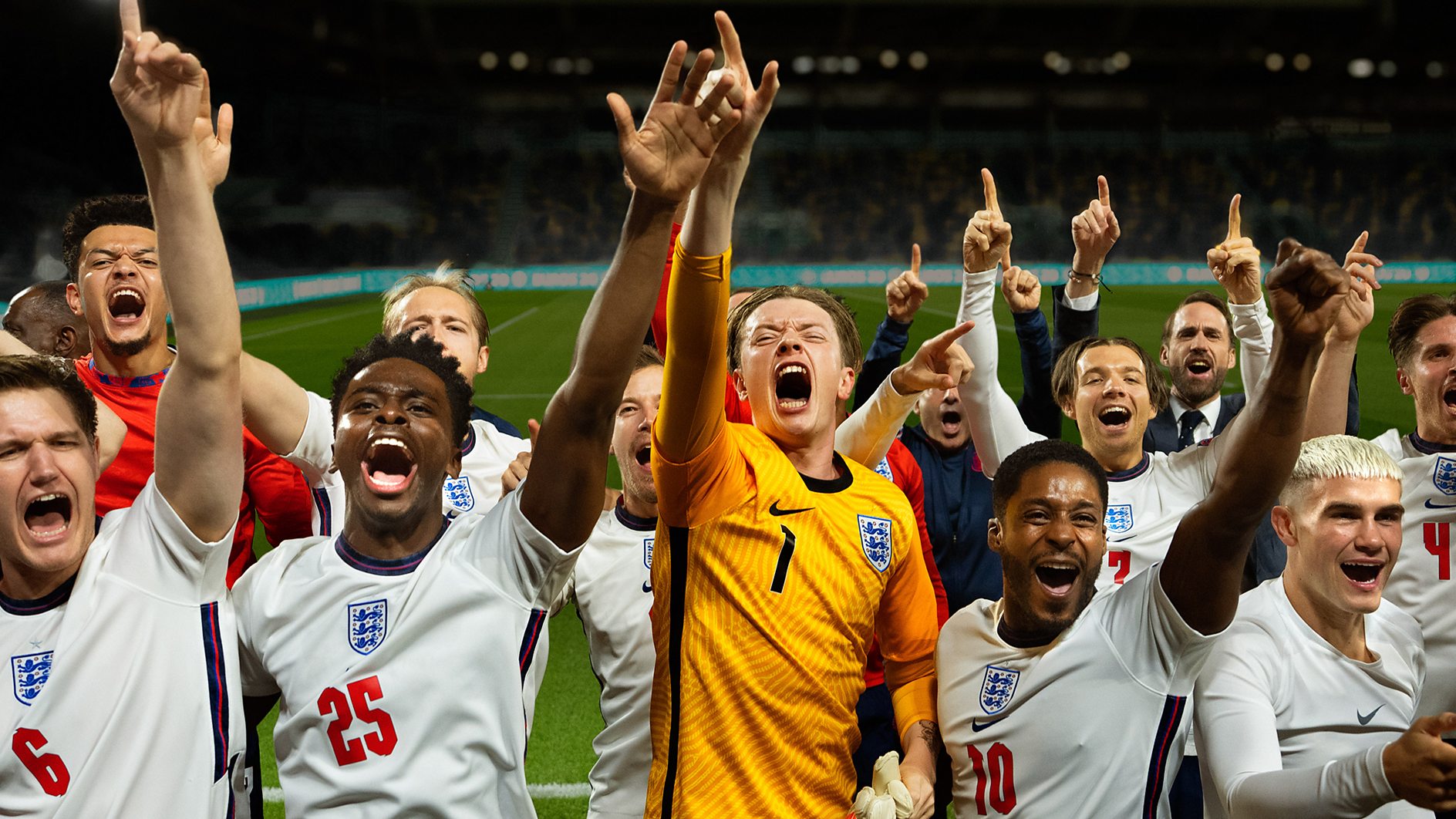
The penalty shootouts are some of the most powerful moments in the series. What made them so interesting from a sound perspective?
There is a specific penalty shootout in one of the episodes that is probably the best example of what we were trying to achieve.
One second you're hearing tens of thousands of people reacting together, and the next you're completely focused on a player making the walk to the penalty spot.
That's what penalties feel like to me. You're standing in front of an entire stadium, but it must feel like the loneliest place in the world.
Were there any sounds that became an unexpected obsession while working on the show?
The football kicks. They're such a recognizable sound, and if they don't feel right the audience might not know exactly what's wrong, but they'll feel it. We ended up recording our own kicks and net impacts because we couldn't quite find what we wanted in existing libraries. Those recordings ended up all over the series.
The sound design often works hand-in-hand with the score. What did that collaboration look like?
I love it when the line between music and sound design starts to disappear. There was a sequence where Gareth is under pressure from the media, and we had recorded keyboard sounds for the typing. Kormac, our composer, asked if he could use those recordings as part of the score.
Suddenly the music and sound effects became part of the same idea. Those are always my favorite moments.


Some of the most powerful moments are surprisingly restrained. How do you know when to pull sound away?
One of the biggest lessons in sound design is knowing when not to add something.
At a certain point in the series, we hold on a character’s face, and everything becomes very restrained before the music arrives. That moment isn’t really about the event anymore. It’s about the person.
Sometimes taking sound away is far more powerful than adding more.
What details are audiences least likely to notice, but which were essential to making the world feel believable?
The little sounds: Grass being brushed before a penalty, socks being pulled up, a shirt moving as a player walks. They're tiny details, but they make the players feel real. If they weren't there, the whole thing would feel flatter.
Looking back on the finished series, what do you hope audiences take away from the sound of Dear England?
If people come away feeling the emotion of those matches rather than thinking about the sound itself, then we've done our job.
The best sound work is often invisible. It's there to support the story, the performances, and the emotion.
If audiences feel the pressure, the hope, the relief, and the humanity at the heart of Dear England, that's the right result.

Credits:
Production: Left Bank Pictures Ltd.
Directors: Rupert Goold & Paul Whittington
DP: Ole Birkeland, BSC
Producer: Tina Pawlik
Editor: Ben Yeates
Exec. Producers: Rebecca Hodgson , Andy Harries & James Graham
Post Production Producers: Bea Arnold & Jules Jackson
Re-Recording Mixer | Nigel Squibbs
Sound Editorial Team | Tony Gibson, Filipa Principe, Oliver Brierley, Tierney Spence, Alex Bird, Darren Banks
Foley | Earthsound Post
Audio Producer | Zoe Fawcett
You can watch Dear England on BBC One now!